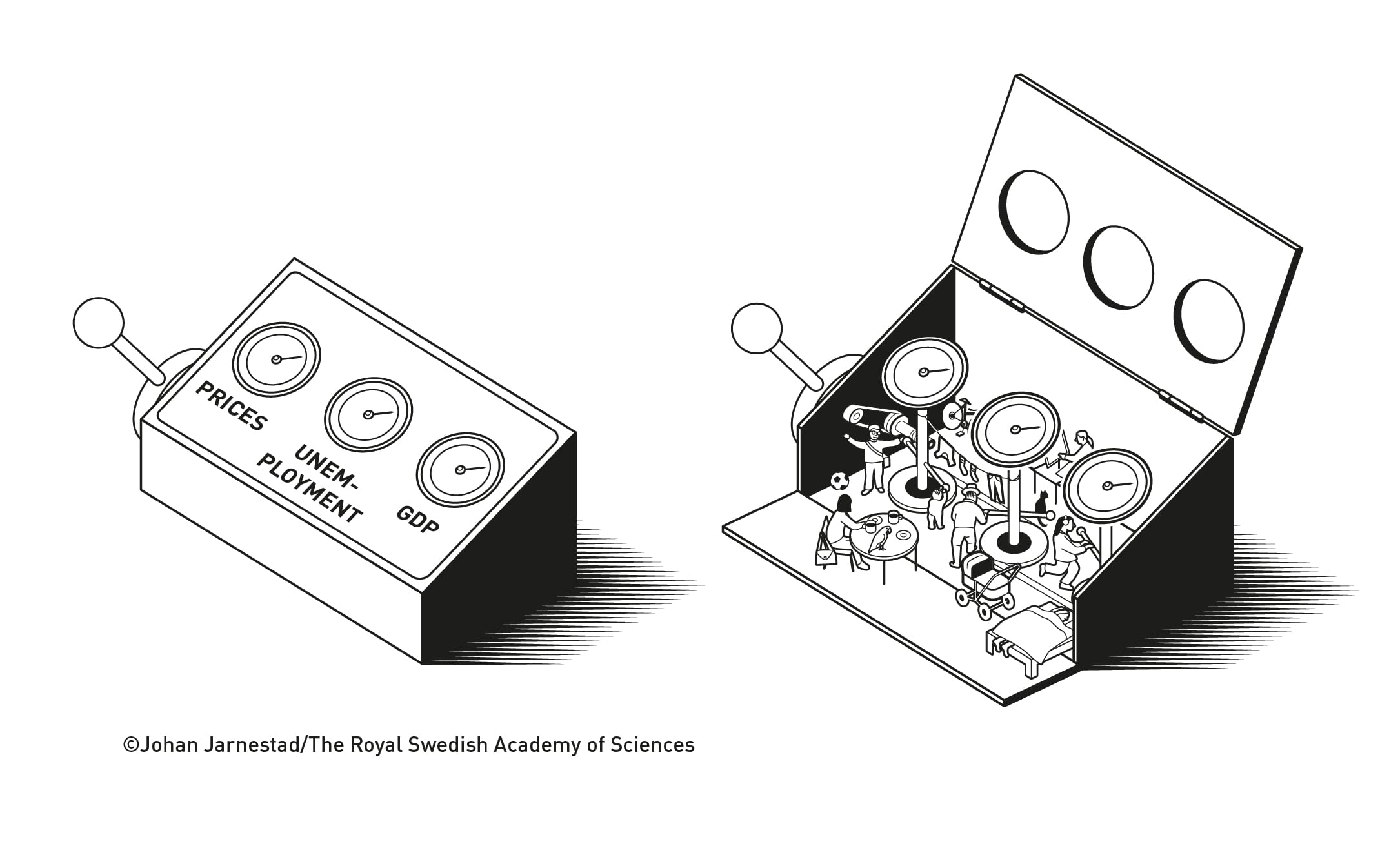
“New Keynesian models are based on microfoundations”, Figure 2 of the 2026 prize announcement. © Johan Jarnestad/The Royal Swedish Academy of Sciences.
On 12 October the 2026 prize in economic sciences went to Robert E. Hall of Stanford and Michael Woodford of Columbia “for microeconomic foundations of macroeconomic stabilisation”. Their work underpins the models central banks use to decide when to raise or cut interest rates. The Royal Swedish Academy of Sciences describes the approach in words that sound very familiar around this project: the models are built “from the bottom up. Economic outcomes are the result of millions of decisions made at the microlevel by households and businesses.”
The BAM model at the heart of BAM Engine comes from a book called Macroeconomics from the Bottom-up. So it is worth asking what the two traditions share and where they part ways.
Same question, different answers#
Both start from the same conviction: you cannot understand the economy by looking only at aggregate statistics. Unemployment, inflation and recessions are the result of choices made by households and firms, so a good model has to start with those choices. This idea gained ground after the 1970s, when models built on historical relationships between aggregate numbers failed to cope with stagflation, and agent-based macroeconomics shares it fully.
The difference is in how the millions of decisions are added up. The prize-winning models make the problem manageable by assuming that, in effect, the economy behaves like one typical household and one typical firm. That household looks ahead and plans the best path of spending it can, given what it expects the central bank to do. This is exactly what makes the models so useful to policymakers: they give clear answers about how interest rates and announcements about future policy affect the economy.
Agent-based models like BAM take the other route. They simulate many different firms, households and banks, each following simple, realistic rules of behaviour and trading with one another in markets that do not always clear. Nobody is typical. Some firms grow, some go bankrupt, some workers stay unemployed for a long time. Booms and recessions are not caused by shocks from outside; they emerge from these interactions, for example when a wave of bankruptcies spreads through the banking system. The authors of the BAM book put their aim plainly: macroeconomics should be understood as emerging from “the continuous adaptive dispersed interactions of a multitude of autonomous, heterogeneous and bounded rational agents”.
Closer than they look#
It would be easy to frame the two approaches as opposites, but the boundary is more porous than that. The mainstream itself has been moving toward heterogeneity: the Academy’s background document singles out models with many different households (so-called HANK models) as one of the most active areas of research building on the laureates’ work. Joseph Stiglitz, a Nobel laureate himself, has co-authored agent-based macroeconomic papers with two of the BAM book’s authors, Domenico Delli Gatti and Mauro Gallegati.
Woodford’s own record is also more interesting than a simple label suggests. In a 1992 Santa Fe Institute working paper, written with the physicist Per Bak and others, he argued that large swings in the economy can arise from many small, independent shocks, with no single big disturbance needed. That is very close to how BAM explains business cycles. And in his first interview as a laureate, he warned against seeing the economy as “some kind of mechanical system that simply moves forward according to certain laws”, insisting that people’s “own understanding of what’s happening is in fact important to what makes the system viable.” An agent-based modeller would happily sign that sentence.
Already at work in policy#
The Academy’s popular summary says of the New Keynesian models that “quite simply, there are no other viable alternatives.” For day-to-day interest rate setting that is a fair description today. But agent-based models have quietly moved from academic papers into the work of real policy institutions, mostly where heterogeneity and financial stability matter most:
- Hungary. In its June 2021 Financial Stability Report, the Magyar Nemzeti Bank used an agent-based model of the housing market, representing “nearly ten million people, four million households”, to test whether loosening loan-to-value limits during the pandemic was a good idea. The model found it would lead to many more households in arrears and loan loss provisions “more than twice as high”.
- Canada. The Bank of Canada built an agent-based model called CANVAS. According to a 2023 paper co-authored by its then Deputy Governor, it became another tool for building inflation scenarios during the pandemic, and was particularly informative about lockdowns and supply chain problems.
- United Kingdom. The Bank of England has developed an agent-based model of the UK housing market and drew on agent-based housing simulations in its 2023 analysis of the buy-to-let sector and financial stability.
- Euro area. The European Central Bank has used an agent-based model to assess how climate change could stress the financial system. Back in 2010, after the financial crisis, ECB President Jean-Claude Trichet said of agent-based modelling that “such approaches are worthy of our attention”. The EU had already funded EURACE, one of the first large-scale agent-based models of a whole economy, between 2006 and 2009.
A 2025 review led by Bank of England researchers found agent-based work at 24 central banks and seven other institutions, including the IMF and the World Bank. It describes these models as “effective complementary tools”, and it is honest that their use in monetary policy “is not yet widespread”. That is the right way to put it: agent-based models are not replacing the prize-winning framework, but they are answering questions it was not designed for.
Why not a Nobel one day?#
Ideas at the root of agent-based modelling have been recognised in Stockholm before. Herbert Simon won in 1978 for showing that real decision makers are limited and settle for good-enough choices. The Academy admitted his theories were “less elegant” than the classic ones but offered “greater possibilities for understanding and predictions”. When Thomas Schelling won in 2005, the committee singled out his model of how mild individual preferences can tip whole neighbourhoods into segregation, which is often called one of the earliest agent-based models. Elinor Ostrom (2009) studied complex systems of many interacting users and discussed agent-based models in her Nobel lecture. In 2021 the physics prize went to Giorgio Parisi for work on complex systems, which he has described as being about “how simple behaviours give rise to complex collective behaviours”. And two laureates, Kenneth Arrow and Philip Anderson, helped launch the Santa Fe Institute’s economics programme in the late 1980s, where much of complexity economics began.
No prize has yet gone to agent-based macroeconomics itself. But the approach now has decades of theory behind it, growing use in central banks, and a clear role in the problems that worry policymakers most: financial crises, inequality, housing markets and climate risk. This year’s prize celebrates one powerful way of building the economy from the bottom up. It is not hard to imagine a future committee celebrating another.
We built BAM Engine to make that other way easier to explore: an open, tested implementation of the BAM model that anyone can run, inspect and extend. If you want to see an economy emerge from thousands of interacting agents, try it in your browser.